Showing posts with label Insect. Show all posts

Friday, April 17, 2009

Lantern Bug (Pyrops candelarius)

Lantern Bug

The lantern bug, especially that of the genus Pyrops, is a favorite among collectors due to their bright patterns.

The lantern bug, also known as “lantern fly” is a very old insect. They have been around for more than 300 million years.

The order of insects in which lantern bugs belong to can be found in three continents – Asia, Australia, and America.

Lantern bugs belong under the fulgorid genus of Fulgora and Pyrops.

Lantern bugs of the Fulgora genus can be found in Central and South America while those under the Props genus can be found in southeast Asia.


Size, shape and colors of the lanter bug.

The lantern bug can grow from 1.5 to 3 inches long from head to thorax and has a wingspan of about 2 to 2.5 inches wide, depending on the species. It has a long beak, called its rostrum, which it uses to suck the juice out flowers and fruits. The lantern bug is an herbivore.

Lantern bugs are called thus because of their bright usually contrasting colors. Their actually coloring varies for each genus but the colors are bright enough for them to earn their name, despite the fact that no lantern bug actually emits any light at all.


Lantern bugs all belong under the order called Hemiptera.

There are actually around 80,000 species belonging under the order. Aside from lantern bugs other insect under the Hemiptera order include cicadas, aphids, shield bugs, etc. Insect belonging all have the distinctive characteristic of having a proboscis with a beak (rostrum) that is designed to pierce tissue and suck fluids, usually sap, out. True bugs undergo metamorphosis several times and the nymphs look a lot like the adults.

The Order Hemiptera is further subdivided into the sub-orders Heteroptera, Auchenorrhyncha, Sternorrhyncha, and Coleorrhyncha. The last three sub-orders where once classified under one sub-order, Homoptera, until since they shared the same wing structure and position of their rostrum. Lantern bugs belong under the sub-order Homoptera.


Spittle bug/froghopper

Spittle bug/froghopper
[昆]沫蝉,吹沫虫
small leaping herbivorous insect that lives in a mass of protective froth which it and its larvae secrete

The froghoppers, or the superfamily Cercopoidea, are a group of Hemipteran insects, in the suborder Auchenorrhyncha. Traditionally, most of this superfamily was considered a single family, Cercopidae, but this family has been split into three separate families for many years now: the Aphrophoridae, Cercopidae, and Clastopteridae. More recently, the family Epipygidae has been removed from the Aphrophoridae. These families are best known for the nymph stage, which produces a cover of frothed-up plant sap resembling spit; the nymphs are therefore commonly known as spittlebugs, or spit bugs, and their froth as cuckoo spit or snake spit. The final family in the group, Machaerotidae, is known as the tube spittlebugs because the nymphs live in calcareous tubes, rather than producing froth as in the other families.
Nymphal form of spittlebug encased in foam for protection and moisture.
The froth serves a number of purposes. It hides the nymph from the view of predators and parasites, it insulates against heat and cold, thus providing thermal control and also moisture control. Without the froth the bug would quickly dry up. The nymphs pierce plants and suck sap causing damage, and much of the excess filtered fluids go into the production of the froth. A few species are serious agricultural pests.

Adult froghoppers jump from plant to plant; some species can jump up to 70 cm vertically: a more impressive performance relative to body weight than fleas. The Frog Hopper can accelerate at 4000 m/s^2 over 2mm as it jumps. Many species resemble leafhoppers, but can be distinguished by the possession of only a few stout spines on the hind tibia, where leafhoppers have a series of small spines. Members of the family Machaerotidae greatly resemble treehoppers, due to a large thoracic spine, but the spine in machaerotids is an enlargement of the scutellum, where treehoppers have the pronotum enlarged. Members of the family Clastopteridae have their wings modified to form false heads at the tail end, an anti-predator adaptation. Many adult Cercopidae can bleed reflexively from their tarsi, and the hemolymph appears to be distasteful; they are often aposematically colored


蟻蛛-蠅虎科

Myrmarachne magna(普)
大蟻蛛(雄)

蟻蛛的身體長得非常類似螞蟻,蜘蛛的身體只有分為兩節,分別是頭胸部、腹部兩節,而昆蟲是頭胸腹三節,所以在蟻蛛的身上頭胸部有個凹陷模擬螞蟻的體態,在行為上蟻蛛常把地一對步足舉在頭頂上,看起來就會很像螞蟻的觸角。
蟻蛛是鋏角亞門的生物,蛛形綱,蜘蛛目,蠅虎科,蟻蛛屬而螞蟻是uniramia亞門,最大的差異是蜘蛛並沒有顎這個構造。螞蟻與蟻蛛的血緣關係從亞門就開始分家,其實血緣相當遠。
蟻蛛不會結網補食但會結網造居,常將葉片上下黏合後在內躲藏。
蟻蛛的奇妙形體可以讓他利用螞蟻的身形躲避敵人(有相當多種生命以擬態螞蟻避敵)本身也會徘徊再蟻徑上補食螞蟻,只要看到一些走路方式不太對的螞蟻
仔細一看,很可能會找到蟻蛛的芳蹤。


蚱蜢


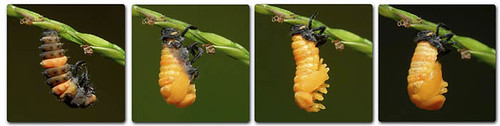
变蛹过程

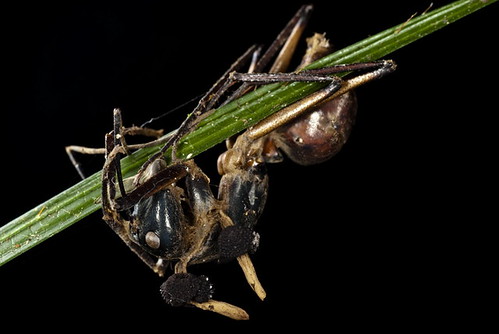
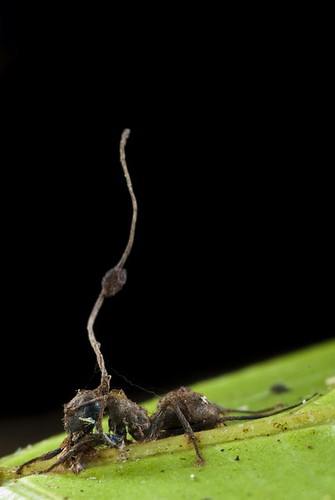
Cordyceps: Attack of the killer fungi


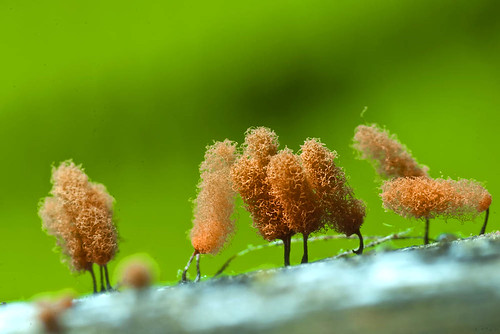
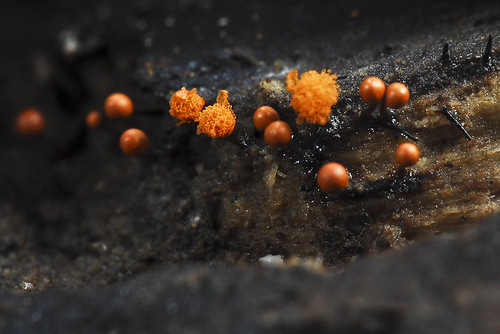
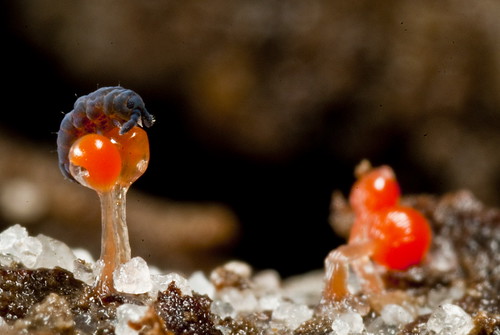
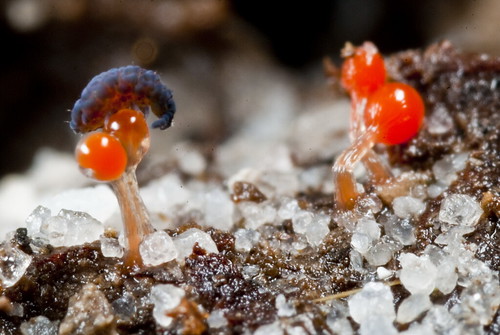
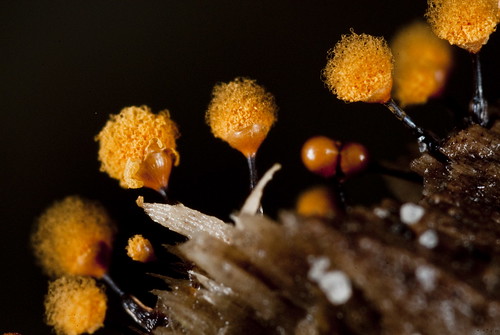
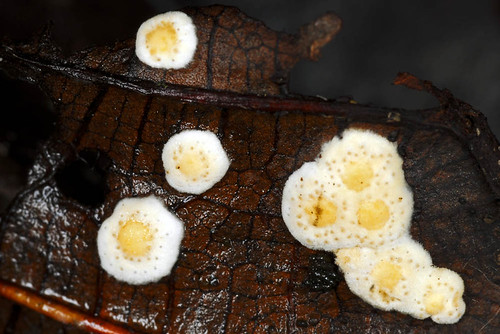
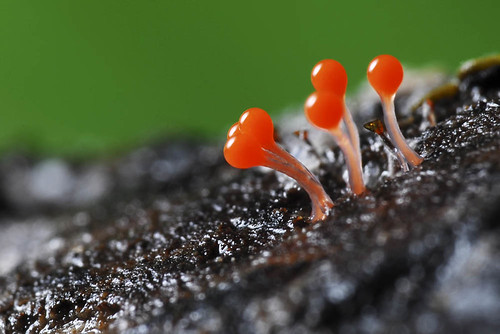
黏菌

黏菌

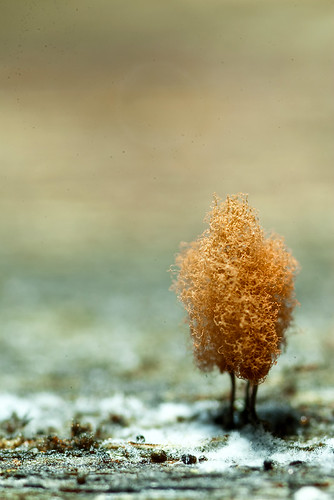
黏菌是一群類似霉菌的生物,會形成具有細胞壁的 孢子,但是生活史中沒有菌絲的出現,而有一段黏黏的時期,因而得名(slime molds)。這段黏黏的時期是黏菌的營養生長期,細胞不具細胞壁,如同變形蟲一樣的,可任意改變體形,故又稱為”變形菌”(荻原博光等, 1995),被歸入和原生動物一樣的生物界: Protozoa (Hawksworth et al., 1995)。在這Protozoa生物界中,黏菌被分成四門(4 phyla);其中的Myxomycota是成員最多的一門,包含兩個綱。下文所講述的是其中的一個綱(class): Myxomycetes,也就是一般人所稱的黏菌。
Myxomycetes又名為真黏菌(true slime molds),以別於細胞黏菌的網柱黏菌門(Dictyosteliomycota)和Myxomycota中的另一個綱: Protosteliomycetes (原柱黏菌綱)。包含六目12科60屬。
黏 菌(Myxomycetes) 大多性喜陰涼潮濕的場所,因而只要足夠潮濕的有基物質都可能成為其棲息之所,常見的棲息地(子實體形成、出現地)有腐木、枯枝、落葉、枯草等腐爛的植物殘 留物。庭院中或野外的活樹幹、樹枝上也常見有其蹤影,特別是在下雨時節過後數天(3~7天),可以看到不少的樹皮黏菌。其他尚有糞生黏菌、雪線黏菌等。在 自然界中,黏菌分佈甚廣,常是世界性的,地區性的黏菌記錄多寡,往往與當地參與採集人員多寡相關,越多有興趣人士參與採集,就會有更多的區域性黏菌種類被 開採發掘出來。常見的黏菌有: Arcyria cinerea(灰團網黏菌)、A. denudata(暗紅團網黏菌)、Cribraria confusa(惑篩黏菌)、Dictydium cancelatum (燈籠黏菌)、Lycogala epidendrum(粉瘤黏菌)、Physarum mellum(淡黃絨泡黏菌)、Stemonitis splendens (大孔美髮網黏菌)等。